Introduction
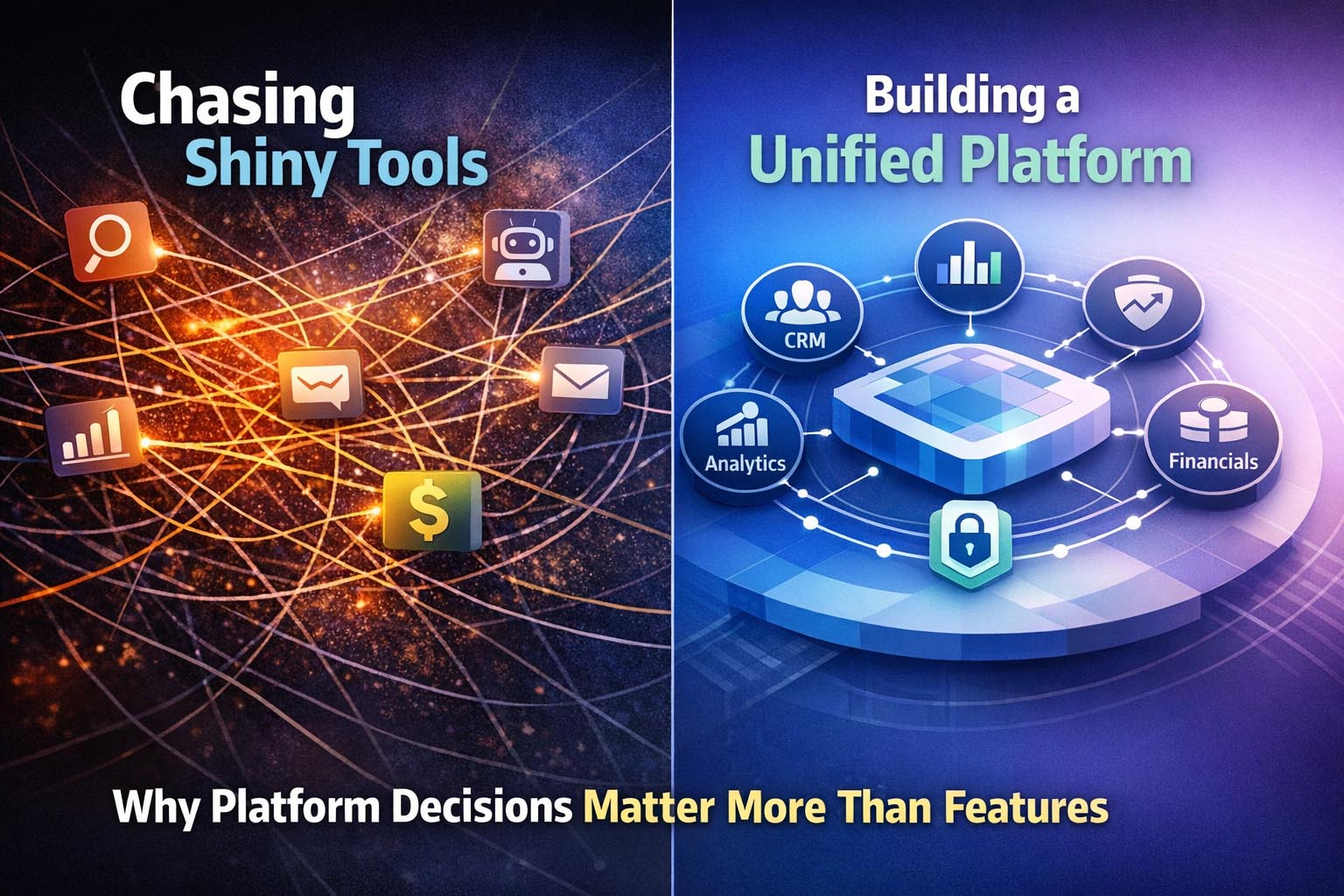
The staffing tech market is full of “must-have” tools: AI sourcing, auto-messaging, workflow bots, analytics overlays. Many are genuinely valuable. But layering tool after tool onto a fragmented core creates a different outcome than promised—higher cost, slower change, brittle integrations, and growing operational risk.
This article explains why platform-first decisions outperform feature-led buying, and why the right foundation matters more than any individual tool—especially as firms push toward AI, automation, and advanced analytics.
Incrementalism: The Hidden Trap
The pattern is familiar:
- Buy a tool to fix a narrow problem
- Integrate it into one or two systems with bespoke mappings
- Hope it still fits next year
Repeated often enough, this creates a web of dependencies—each tool holding its own data assumptions, sync rules, and failure points. Every core change increases regression risk. Innovation slows, even as spend rises.
Incrementalism feels safe because each step is small. In reality, it accumulates architectural debt that’s hard to unwind.
Platform > Product: What Actually Changes
A platform-first strategy doesn’t reject tools—it changes how they’re used.
Key differences:

A shared data model across core business applications
Reusable, governed APIs instead of one-off pipelines
Centralized security, access, and compliance

The ability to plug in, test, and remove tools without destabilizing the core
This is how large, complex staffing organizations operate at scale. Their foundation is stable.
Tools enhance it—they don’t prop it up.
The BI Symptom: When Reporting Becomes the Architecture
Business intelligence often exposes platform weakness first.
Many firms end up replicating operational data into multiple reporting layers—not because analytics at scale are wrong, but because source systems don’t agree on the truth. Reconciliation, transformation, and exception handling become permanent features of the BI stack.
A strong platform changes this dynamic.
- Micro-level analytics (job profitability, placement margin, real-time P&L impact) can run close to the transaction layer, where accuracy and timeliness matter most.
- Macro-level analytics (trends, mix, utilization, performance over time) belong in a performance-optimized analytics environment—but one fed directly and consistently from governed source data.
The goal isn’t fewer layers for their own sake. It’s fewer unnecessary layers created solely to compensate for fragmented systems.
A typical case in point
A mid-sized staffing firm consolidated CRM, ATS, and back office operations onto a Microsoft-first platform:
- Retired two middleware products and three bespoke connectors
- Simplified operational reporting by standardizing source data
- Reduced BI licensing and maintenance costs by approximately 40%
- Cut weekly reconciliation time from 12 hours to under 2
Operational insight moved closer to transactional data, while macro analytics ran in a dedicated, high-performance model fed from the same governed foundation. The result was faster insight without sacrificing scale or performance.
Decision Framework: Are You Platform-First?
Ask yourself:
Data model:
Do core systems share data, or copy it?
Integration:
Are connections reusable and real-time, or bespoke and brittle?

Financials:
Can micro events flow directly into margin and P&L visibility?
Analytics:
Is macro reporting fed cleanly from trusted sources—or stitched together?
Experimentation:
Can tools be added or removed without re-engineering integrations?
Conclusion
Features come and go. Platforms endure.
The same foundation that enables AI, automation, and analytics determines whether your technology stack accelerates innovation—or quietly resists it. Stop chasing incremental tools to patch structural gaps. Invest in the platform that makes everything else faster, safer, and easier to change.
See a 20-minute demo: Prospect-to-P&L on a Microsoft-first stack.
Let’s talk - or book a demo of 1Staff in action.
More from the blog!
Stuck in a Maze of Systems?
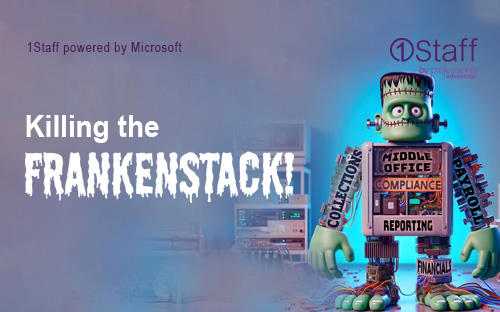
In this blog, we’ll look at what a Frankenstack really is, why it’s so damaging to your financial operations, and how an integrated solution like 1Staff on Microsoft Dynamics 365 Business Central replaces chaos with clarity.
Read more...
From GP to Great
Reimagine Your Back Office with 1Staff 365
With Dynamics GP nearing end of life, now is the time to plan your next step. See how 1Staff 365 on Microsoft Dynamics 365 Business Central can modernize your back office with automation, flexibility, and measurable savings.
Read more...