If 2025 felt uncertain, the outlook for 2026 suggests staffing leaders should prepare for more complexity rather than a clean rebound.
According to SIA’s Staffing Trends 2026 report, the industry is operating in a market that now looks fundamentally different from the one many firms knew before Covid. The report highlights seven major trends shaping the year ahead, from cautious growth expectations to AI governance, candidate fraud, direct sourcing, and the blurring of lines between staffing firms, platforms, and workforce technology providers.
For staffing firms, this is less about waiting for the market to “go back to normal” and more about adjusting to what the new normal actually is.


The post-Covid staffing market is here to stay
One of the strongest messages in the report is that the staffing market has become structurally different. Pre-Covid conditions were marked by lower inflation, more stable work patterns, and a more predictable labor market. In contrast, today’s market is more geographically flexible, more volatile, and more affected by changing workforce participation and migration patterns.
That matters because it suggests firms can’t simply rely on old playbooks. Agility, visibility, and the ability to respond quickly to shifts in demand are becoming more important than ever.

Growth may return, but don’t expect a dramatic rebound
The report takes a cautious view of the year ahead. Rather than pointing to a major recovery, it suggests 2026 is more likely to be a year of modest progress.
For many staffing firms, that means growth strategies will need to be more deliberate. Winning market share, improving operational efficiency, and protecting margin may matter more than simply waiting for market conditions to lift everyone at once. This kind of environment tends to reward firms that are tightly run and clear on where they can differentiate.

AI is growing fast, but so are governance concerns
AI remains one of the biggest forces shaping staffing, but the report makes it clear that the conversation is shifting. It’s no longer just about innovation. It’s also about ethics, trust, governance, and compliance. SIA identifies “AI Ethics Bumps Up Against AI Innovation” as one of the defining trends for 2026.
That is an important shift for staffing firms. AI can absolutely help with productivity, matching, communication, and decision support. But firms also need confidence in how data is handled, how recommendations are made, and how risk is controlled. In 2026, it won’t be enough to say a platform has AI. Buyers will increasingly want to know whether that AI is governed properly.
For firms already operating in the Microsoft ecosystem, this is one area where the underlying platform can do a lot of the heavy lifting — security, compliance controls, and auditability are baked into the architecture rather than bolted on afterward.

Candidate fraud is becoming harder to ignore
SIA also highlights the increase in candidate fraud as a major trend for the year ahead. The report points to several forms of fraud that employers and staffing firms need to watch closely: résumé misrepresentation, identity fraud and impersonation, and AI-assisted fraud such as fabricated experience, proxy interviews, and deepfake-style video deception.
Frankly, this section deserves more attention than it typically gets in these conversations. The report even cites Amazon’s disclosure that it had blocked more than 1,800 job applications from suspected North Korean operatives, using a mix of AI-powered screening and human verification. That’s not a hypothetical risk — it’s happening now, at scale, to firms most people would consider well-resourced.
The report also notes that risks are especially high in remote and cross-border hiring, where verification practices may not always be strong enough.
This trend reinforces the idea that speed alone is not enough. Staffing firms need processes and systems that help verify identity, detect anomalies, and strengthen trust throughout the hiring lifecycle.

Direct sourcing continues to pressure traditional intermediaries
Another clear theme is the steady rise of direct sourcing. SIA notes that employers have always had multiple options for filling roles and that using a staffing firm is just one of several routes available to them. Internal recruitment, employee referrals, careers sites, social channels, campus recruitment, and sector-specific walk-ins all form part of the direct sourcing mix.
For staffing firms, this doesn’t mean the intermediary model disappears. But it does mean firms need to offer more than basic access to talent. The more employers build their own sourcing capabilities, the more staffing firms need to differentiate through speed, specialization, service quality, compliance support, talent communities, and technology-enabled workflows.

The lines between firms, platforms, and tech providers are blurring
SIA’s report also includes a section called “Everything is Merging,” which may be one of the most relevant trends for staffing technology vendors and staffing leaders alike.
The message is that the industry is becoming less neatly defined. Staffing firms, talent platforms, outsourcing providers, and workforce technology companies are increasingly moving into overlapping territory. As this happens, firms may find themselves rethinking what services they offer, how they package value, and where they fit in a changing ecosystem.
For software providers, this creates a strong case for platforms where front office, middle office, and back office actually share a data model — rather than systems that are integrated in name but siloed in practice. For staffing firms, it suggests that platform capability, data flow, and operational visibility will become even more important selection criteria going forward.

Firms are looking for growth in adjacent services
The report’s final highlighted trend is that staffing firms are increasingly seeking growth in adjacent services.
That makes sense in a slower-growth market. If core temp and perm hiring remain under pressure, firms are likely to explore additional revenue streams that improve customer stickiness and create more value. This could include areas such as compliance support, onboarding services, workforce analytics, consulting, or broader managed service offerings.
For staffing leaders, the question becomes: where can we expand in ways that are profitable, scalable, and aligned with what clients now need?
What this means for staffing firms in 2026
Taken together, these trends point to a market that is not necessarily shrinking in importance, but is becoming harder to navigate with old assumptions.
In 2026, successful staffing firms are likely to be the ones that can adapt to slower and more uneven market conditions, use AI responsibly rather than just aggressively, and strengthen candidate verification before it becomes a liability. The firms that compete effectively in a world of growing direct sourcing will be those that have genuinely reduced tech fragmentation — not just integrated systems in name — and found new opportunities in adjacent services that their clients actually value.
The big opportunity may not be in doing more of the same. It may be in building a more resilient, trusted, and connected business model for the market that exists now — one where the technology decisions made today don’t create the integration headaches of tomorrow.
Bridge to the Cloud 3
Key Dates for 2026–2027
Microsoft has announced Bridge to the Cloud 3 (BTC3), a time-limited licensing promotion for organizations still running Microsoft Dynamics GP and planning a transition to the Microsoft cloud.
Read more...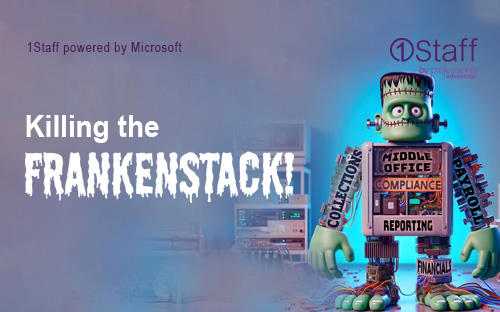
More from the blog...
Killing the Frankenstack!
Why Your Back Office Architecture Is Holding You Back!
Killing the Frankenstack!