Introduction
AI promises to transform staffing - faster placements, predictive insights, automated workflows, and margin protection. Yet many AI initiatives stall for a simple reason leaders often discover too late: AI cannot succeed without clean, connected data.
If your CRM, ATS, compliance, payroll, and reporting systems each maintain their own version of the truth, you are asking AI to learn from noise. This article explains why clean data is the hidden prerequisite for AI in staffing, how to recognize when your architecture is blocking progress, and why a Microsoft-first approach provides a durable foundation.

The Problem: A Frankenstack Built by Accident
Most staffing firms didn’t choose complexity - it accumulated over time:
- A CRM optimized for sales velocity
- An ATS selected by operations
- A compliance tool to manage risk
- A payroll or ERP system tailored for finance
- Middleware added to connect everything
- A BI project to “make sense of it all”
Each system works. Each also maintains its own dataset. The result is multiple versions of the same worker, account, job order, and assignment.
AI engines struggle in this environment. They can’t reliably interpret patterns across duplicated and loosely synchronized records. The outcome is predictable: garbage in, garbage out - only faster and more expensive.
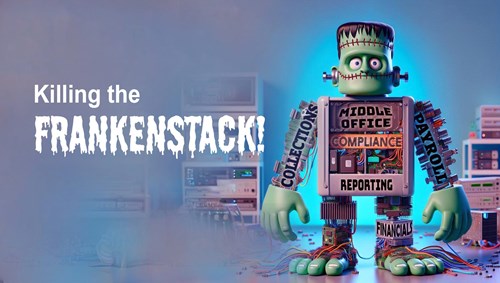
Read our blog 'Killing the Frankenstack' - Why Your Back Office Architecture Is Holding You Back!
Why Clean Data Matters for AI
For AI to deliver real business value, data must be consistent across the full staffing lifecycle. Clean, connected data allows AI to:

Detect relationships
account → job orders → placements → margins

Identify patterns
cancellation risk, funnel leakage, time-to-fill trends

Learn holistically
a candidate’s journey from application to assignment to payroll
When data is fragmented, AI sees disconnected fragments of reality. When data is unified, AI can answer the questions leadership actually cares about - profitability, risk, speed, and customer experience.
The Breakthrough: One Concept of an Account with Microsoft Dataverse
A better approach starts with a unified operational data model.
In a Microsoft-first architecture, sales, operations, and compliance live in Dynamics 365 applications built on Microsoft Dataverse. Dataverse holds the shared tables for accounts, contacts, candidates, jobs, assignments, activities, and compliance artifacts.
From there, Dataverse becomes the authoritative operational source, synchronizing clean, governed records into the financial system of record - 1Staff Back Office and Microsoft Dynamics 365 Business Central for financials and payroll.
What this enables: - Operational single source of truth: One account, one candidate, one assignment—created and managed once in Dataverse - Clean downstream financials: Financials and payroll receive validated, standardized records instead of reconciling duplicates - Real-time to near-real-time sync: AI, analytics, and automation operate on live operational data while finance remains protected - Clear system boundaries: Dataverse for operational intelligence; Business Central for financial control
This approach avoids bi-directional chaos while preserving a clean, AI-ready operational core.
Symptoms You’re Not AI-Ready (Yet)
If these sound familiar, you likely have a data foundation problem—not an AI problem: - Multiple “master data” sources for customers or talent - Overnight batches or weekly syncs for critical workflows - Staging tables required just to process transactions - BI initiatives that outweigh investment in core systems - Manual reconciliation between payroll, billing, and reporting
AI won’t fix these issues. It will amplify them.
Quick Wins - or Hard Truths - on the Path to AI Readiness
Not every platform can realistically support an AI-first future. One of the most important executive decisions is recognizing whether you are making incremental progress or simply investing more to stand still.
Before committing additional budget, ask an uncomfortable but necessary question: Are we improving the foundation—or compensating for it?
When Small Add-On Wins Make Sense
Incremental improvements are viable when: - Your core platform already has a coherent data model, even if it’s imperfect - Duplicates exist, but ownership of master data is clear - Integrations are mostly API-based, not file-driven - Middleware supports edge cases—not core business logic
In these scenarios, targeted investments can pay off: 1. Defining and enforcing master data ownership 2. Replacing batch jobs with near-real-time APIs 3. Simplifying reporting to rely on operational tables 4. Introducing AI features where data quality is already strong
These are genuine quick wins because they compound over time.
When to Recognize the Platform Isn’t Fit for the Journey
There is a tipping point where continued investment becomes counterproductive. Warning signs include: - The platform fundamentally stores the same entity differently across modules - Reconciliation logic lives permanently in middleware - AI features require extensive data prep or manual curation - Reporting depends on rebuilding the business in a separate warehouse - Each new capability increases fragility instead of clarity
At this stage, additional spend rarely delivers strategic advantage. You may achieve isolated automation wins, but AI at scale remains out of reach.
The harder—but often cheaper—decision is to acknowledge that the platform was not designed for unified data or modern AI workloads.
The Strategic Pivot
Organizations that succeed don’t chase perfection. They: - Protect finance and payroll in a true system of record - Establish a clean operational core for sales, operations, and compliance - Let AI learn from the system where work actually happens
This shift is less about ripping and replacing everything—and more about stopping investment in architectures that cannot converge.
Dataverse becomes the authoritative operational source, synchronizing clean, governed records into the financial system of record.
Executive Checklist: Are You AI-Ready?
 We have a single, authoritative operational record for accounts and candidates
(Created once, governed centrally, and referenced consistently across systems)
Core operational processes do not depend on file transfers, batch jobs, or staging tables
(Exceptions exist, but they are not required for day-to-day execution)
Reporting is driven from governed operational data, not reconstructed or duplicated datasets
(No shadow ledgers, parallel warehouses, or reassembled relationships)
Middleware supports edge cases—not core business logic or data ownership
(Integration enables the platform; it does not compensate for it)
Finance can trace transactional detail to margin and profit using aligned, auditable data structures
(Operational events and financial outcomes remain logically connected, even if systems differ)
If you can’t check most of these boxes, AI outcomes will remain limited.
Conclusion
AI, automation, and analytics can’t create clarity from chaos. Clean, connected data is the prerequisite - not the byproduct - of successful AI.
A Microsoft-first stack makes a clean core the standard, not an afterthought. Build the right foundation, and AI becomes practical, scalable, and profitable.
Want a 30-minute AI Readiness Assessment?
We’ll review your tech stack, identify the top three data blockers, and outline how to remove them.
From GP to Great
Reimagine Your Back Office with 1Staff 365
With Dynamics GP nearing end of life, now is the time to plan your next step. See how 1Staff 365 on Microsoft Dynamics 365 Business Central can modernize your back office with automation, flexibility, and measurable savings.
Read more...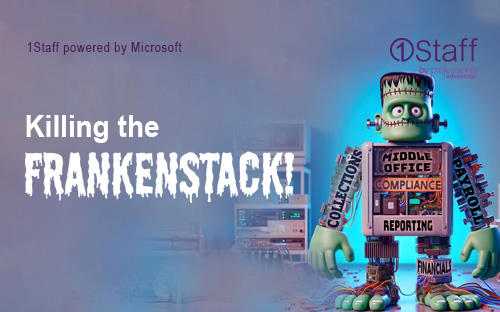
More from the blog!
Stuck in a Maze of Systems?
In this blog, we’ll look at what a Frankenstack really is, why it’s so damaging to your financial operations, and how an integrated solution like 1Staff on Microsoft Dynamics 365 Business Central replaces chaos with clarity.
Read more...