A timesheet line's life doesn't begin or end when it's entered. It may originate in a VMS, a time capture system, an API, or even an imported file. It gets adjusted, sometimes more than once. It posts to pay. It posts to bill, often at a different time for reasons that have nothing to do with each other. On-costs get applied somewhere along the way. Eventually it lands in the G/L several steps and possibly several days removed from where it started.

The Visibility Gap Between Systems.
When someone asks what actually happened to a given line from start to finish, the honest answer used to mean chasing it across multiple ledgers by hand, checking one system for the adjustment history, another for pay status, another for bill status, then reassembling the story yourself. No individual system was failing at its job here, it's just what happens when no single place is responsible for tracking a line through its whole life.
How do we solve that? With the Consolidated TS Ledger. It tracks each timesheet line across its full arc. From the source and original entry through every adjustment, pay status, bill status, on-cost attribution, and eventual G/L posting. This includes who made a change, when, why, and where it originated. All in one record you can follow from beginning to end, regardless of how many separate pipelines touched it along the way.
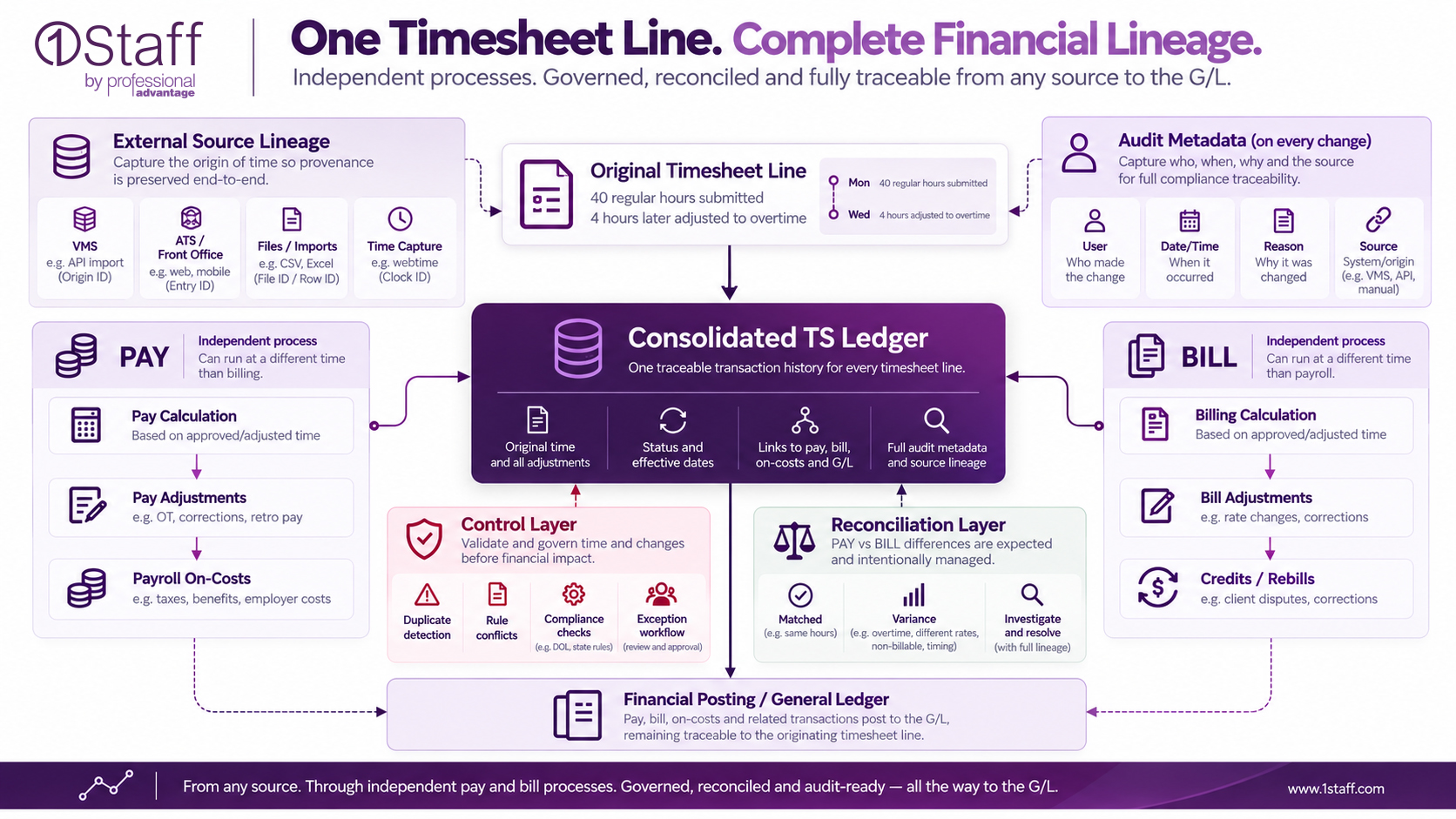
That last part matters more than it might seem. Pay and Bill are designed to run independently. Theres different timing, different rule engines, all by necessity rather than accident. A consolidated ledger doesn't undo that separation. It just means the separation no longer costs you visibility. In addition to that, a difference between pay and bill isn't necessarily an error either. The ledger makes those differences visible and explainable, so expected variances can be distinguished from exceptions that need investigation. You can still ask what happened to a specific line at any point and get a straight answer instead of a research project.
This is an architecture story more than a features story. It’s less about a new screen and more about traceability, with controls and auditability being built into the transaction lifecycle rather than reconstructed after the fact whenever someone needs them. Duplicate transactions, rule conflicts, and other exceptions can be identified and routed for review before they become unexplained financial outcomes.
With 1Staff, tracing a timesheet line becomes part of the staffing workflow rather than a separate research project sitting off to the side. The Consolidated TS Ledger connects original entry, adjustments, pay status, bill status, and G/L posting directly to that same line, helping finance and audit teams answer what actually happened without chasing it across systems, catch inconsistencies earlier, and trust that independently-run pipelines still add up to one coherent record.
“Separate pipelines can still add up to one coherent record.”
See how 1Staff can give your finance and audit teams a clearer view from timesheet entry through to G/L.
The Reconciliation Tax Nobody Budgets For.
“The real cost isn’t the mistake, it’s how long it goes undetected.”
Discover how 1Staff helps staffing firms simplify VMS reconciliation, catch discrepancies earlier, reduce manual work, and prevent small errors from quietly eroding margin.
Read more...
More from the blog...
When One Bad Week Shouldn't Ruin the Other.
A biweekly timesheet arrives as a single scanned image. Week one is clean: hours logged correctly, signatures in place, nothing to flag. Week two has a problem, maybe an illegible entry, maybe a rate that doesn't match the assignment.
Read the blog...