Why AI value in staffing depends on what you built underneath it.
1Staff's Jonathan Marcer attended SIA CollaborationX last September, where Kevin O'Neill first framed many of the ideas that found their way into this report. The roundtable was blunt about where AI was actually stalling in staffing firms — not because the tools were missing, but because the infrastructure underneath them wasn't ready. One line from that session stuck: "Integration is where AI agents go to die."
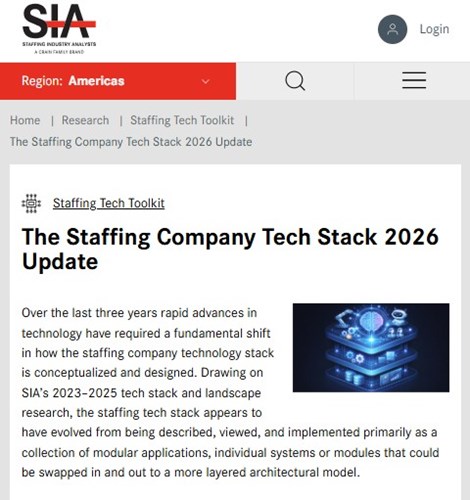
When SIA published the Staffing Company Tech Stack 2026 Update in February, it was the formalised version of that conversation — and it makes an argument that a lot of staffing executives have been circling around for the past two years without quite landing on it.
The argument is this: competitive advantage in staffing technology is no longer determined by which applications you have. It is determined by what is underneath them — the coherence of the data model, the maturity of the integration layer, the governance that runs across the whole stack. Tools are the visible part. Architecture is the part that determines whether those tools actually work.
Firms that treat the tech stack as a strategic asset and who continuously review it against business outcomes are positioned to scale automation and AI use, manage risk and adapt to platform-led workforce models more effectively than those relying on fragmented or legacy environments.
That is a significant shift from how most staffing firms have historically bought technology — as a series of individual decisions, each one solving a specific problem, each one adding another integration to maintain.
The model that actually matters
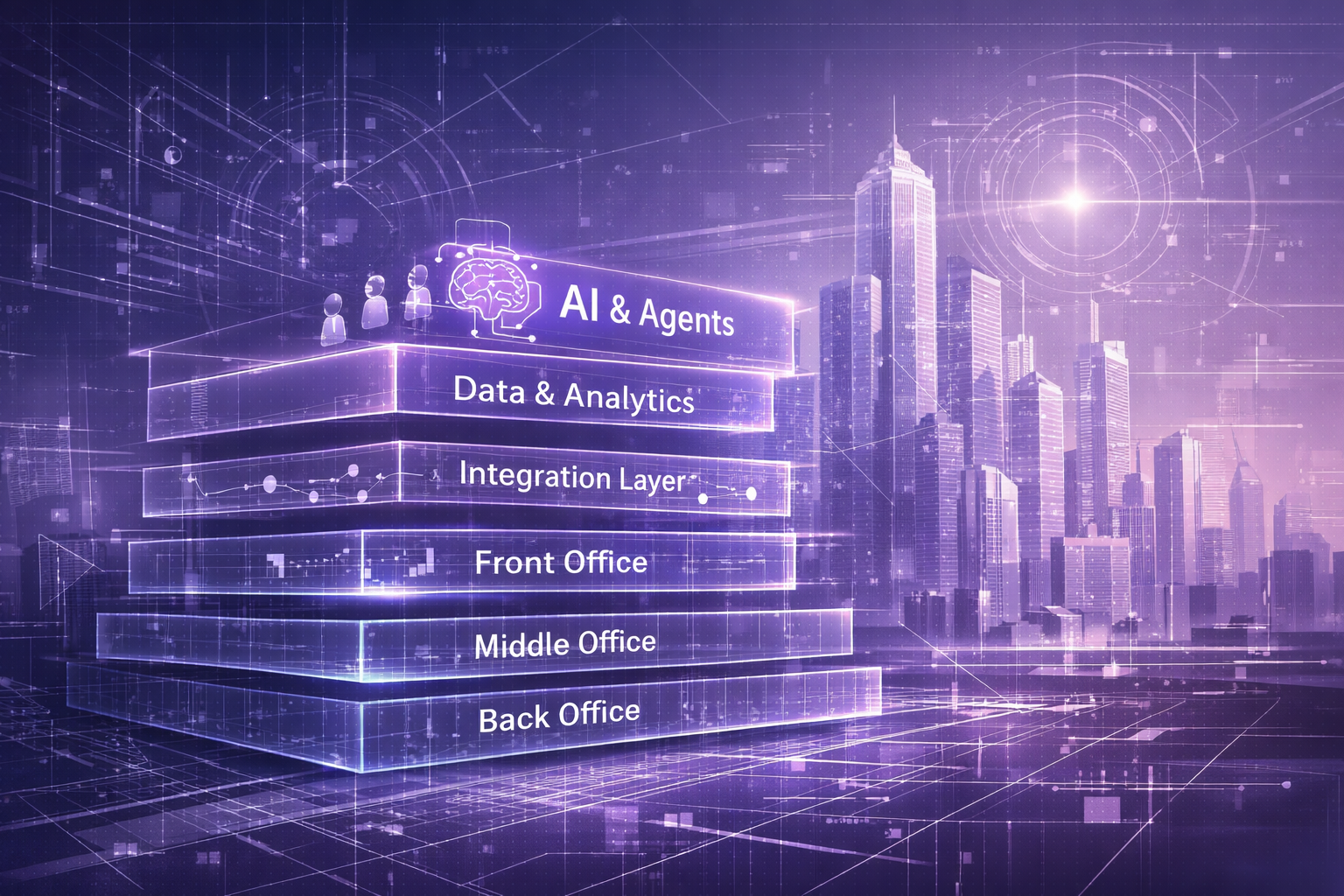
The report describes the modern staffing stack as a series of layers, not a collection of applications. Front office, middle office and back office sit at the base — processing and storing data across the full recruiter and worker lifecycle. Above that, an integration fabric moves data between those systems in real time. Above that, a data and analytics layer contextualises it. At the top, AI and agentic capabilities consume it.
The practical implication runs in both directions. A recruiter using an AI assistant to shortlist candidates is working at the top of that model. Whether that AI produces useful output depends entirely on what is underneath it — whether the candidate data is structured consistently, whether the job order flows cleanly from the front office into the assignment, whether the same worker exists as a single coherent entity from application through to payroll. The front office experience is only as good as the architecture it sits on.
This matters because most staffing firms have treated front office and back office as separate purchasing decisions. A strong ATS paired with a capable payroll system, connected by an integration that mostly works. The SIA report is arguing — and the CollaborationX roundtable made the same point — that this separation is now the primary constraint on AI adoption. You cannot build an intelligent recruiter workflow on a fragmented data model, no matter how capable the front office tool is.
SIA is direct about this:
"AI value in staffing is constrained far more by data fragmentation and inconsistency than by models." At CollaborationX, the same point landed more bluntly: "If your data is messy, AI will make it worse — at scale."
Firms investing in AI tools before addressing architectural coherence are building on foundations that will limit them.
Where 1Staff sits in this
1Staff is not a staffing platform that connects to Microsoft. It is a native part of the Microsoft architecture — a Power App that operates within the same unified environment as Dynamics 365 Sales, Business Central, Power Platform, and the full Azure AI stack. There is no integration layer between 1Staff and Microsoft because there is no separation to bridge.
The front office is 1Staff running on Dynamics — the same world-class CRM and sales engine used by enterprise organizations globally, with staffing-specific workflow and intelligence built natively on top of it. The paybill is not integrated with Business Central. It is native Business Central functionality — meaning the full financial and operational depth of one of Microsoft's flagship ERP products is what powers pay, bill, and compliance for 1Staff clients. Power Platform connects and extends across both, with automation, reporting, and AI capabilities that apply natively to everything in the environment.
When a recruiter works a job order in 1Staff, they are working natively within the Dynamics 365 platform itself — 1Staff is a native layer of that environment, not an application sitting on top of it. When payroll runs, it runs in Business Central as native functionality. When 1Staff Copilot surfaces an insight, it is drawing on the same data platform that underlies the entire operational Microsoft business applications stack. That is what native part of the Microsoft architecture actually means. Every Microsoft AI capability — Copilot, Azure AI Foundry, Power Automate, the full analytics stack — is available because 1Staff clients are already inside that architecture. There is nothing to unlock and nothing to integrate. That compounding advantage is exactly what the SIA report is describing, and it widens with every capability Microsoft adds.
Consider what that means in competitive terms. Microsoft invests more in AI annually than most staffing software vendors generate in total revenue. Every advance — in agentic AI, in natural language processing, in predictive analytics — flows directly into the architecture 1Staff clients are already running on. A platform that integrates with Microsoft will always be playing catch-up to one that is Microsoft. The asymmetry is structural, not temporary.
There is one other point worth making, which Jonathan raised at CollaborationX and which the SIA report addresses directly in its governance layer: explainability. As AI gets embedded deeper into recruiter workflows — shortlisting, matching, engagement — the inability to explain outcomes becomes a liability. "The thing that will stop a business is being sued because someone asks: 'Explain why I didn't get hired.'" Building on a governed, auditable Microsoft architecture means that explainability is not an afterthought — it is part of the foundation.
The Frankenstack problem has a deadline
The SIA report does not use the word Frankenstack. But it describes the condition precisely: legacy systems coexisting alongside modern applications, fragile point-to-point integrations, data models that do not resolve across systems, AI initiatives that stall because the infrastructure cannot support them.
Most staffing firms recognise the description. The stack grew organically — each tool solving a real problem at the time, each integration adding something to maintain. The result is a coherent-looking architecture that fragments the moment you ask it to support something new. The AI pilot that doesn't scale. The reporting that requires a manual extract. The candidate who appears three ways in three systems. The recruiter who re-enters data at every handoff because the front office and the back office don't actually share a record.
These are not just operational frustrations. They have financial consequences — margin leakage that doesn't surface until month-end, billing disputes that extend DSO because the time data and the rate card live in different systems, reconciliation overhead that consumes back-office capacity that should be doing something else. The SIA report identifies eleven triggers for replacing or upgrading the stack. Several show up on the P&L before they show up on a technology roadmap.
The era of the Frankenstack is running out of road. The firms that recognise the architectural problem — rather than treating each symptom as a separate product decision — are the ones that will actually close the gap.
The architecture decision is the AI decision
The SIA Staffing Company Tech Stack 2026 Update frames it as clearly as any research we have seen: competitive advantage in staffing technology is no longer determined by which applications you deploy. It is determined by the coherence of the architecture underneath them. The firms that understand this now — and make platform decisions accordingly — will be in a fundamentally different position when agentic AI capabilities mature and the integration layer becomes the difference between using them and watching competitors use them.
That is not a future problem. It is a present one. The AI pilot that stalls, the margin report that requires a manual extract, the client RFP that asks for integration capabilities the stack cannot deliver — these are architectural symptoms, not product gaps. Adding another tool does not resolve them.
1Staff is built for firms ready to make that architectural decision — to operate natively within the Microsoft platform rather than around it, and to inherit everything Microsoft builds next without asking a vendor to catch up. If that conversation is relevant to where your firm is heading, we would like to have it.
More from the blog...
Killing the Frankenstack!
Why Your Back Office Architecture Is Holding You Back!
Killing the Frankenstack!
Bridge to the Cloud 3
Key Dates for 2026–2027
Microsoft has announced Bridge to the Cloud 3 (BTC3), a time-limited licensing promotion for organizations still running Microsoft Dynamics GP and planning a transition to the Microsoft cloud.
Read more...